
Why did John Report it?
Thoughts on John 6:16-25
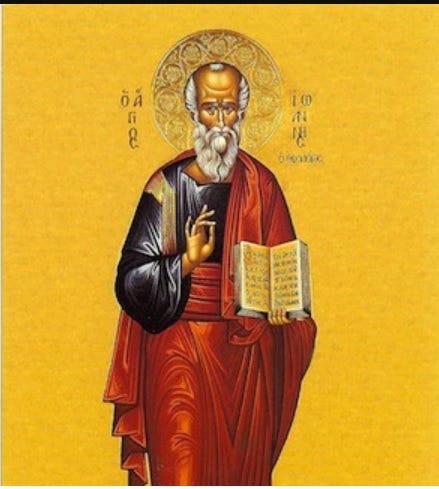
The Gospel According to John is one of the most theologically rich writings that contains a depth that will constantly grow you. For example, the first read through, you can see that John makes a convincing argument to the divinity of Jesus. The second read through, you may learn of what the love of God entails. The third read through, you may recognize the protection of the flock or maybe what it means to be repentant and born-again. Regardless, each read has a depth that has the ability to grow the body beyond generic faith while exposing attributes you may not have once noticed before.
However, this understanding also leads to a flaw to overanalyze John’s text. To create an allegory about every word or every story or to focus too much on the use of specific words. These aren’t bad, unless you are adding to the story, and most of the time they are “non-issues” because we believe these additions just make sense from our worldly view. Often, people add emotions to Jesus that aren’t recorded or they misinterpret his emotions because John tends to write on the side of compassion. They will say he grieved when John doesn’t record it or they will say his use of a word is less harsh. Instead, we should focus on the text provided. Because we recognize that John writes theologically, rather than chronologically, that his choice of words and stories are important. His use of stories appear to be linear but he chooses which ones that occur to tell a deeper picture. And this is where our conversation begins today.
John 6 has an odd break in it. The chapter begins with 15 verses that relate to feeding of the 5,000 men and the final 46 verses revolving around what it means that Jesus is the bread of life. Therefore, in the 71 verses of John 6, 61 verses are about Jesus and bread. Why would John, then, break this flow of exposition with Jesus walking on the water? He has already been depicted in the synoptics with controlling the environment and John has seen many comparable miracles or signs and still included this passage. In fact, John doesn’t refer this as a sign or attesting miracle as he did with the feeding of the 5,000 (John 6:14, 26). Is it because John’s use of signs tend to be for a group greater than the disciples or is he telling us a characteristic of the storm that only the disciples saw what had happened?
Since he doesn’t mark this as a sign, this was not a miracle that John meant to be an attestation of being God. Yes, John clearly acknowledges that this was supernatural act, but he glosses over the miracle event. It was a non-issue for John. Unlike Matthew and Mark, John barely describes the act of Jesus walking on water, doesn’t talk about the storm calming down, and doesn’t record the response of the disciples. I find it hard to think that John included this story if it was meant to serve as a sign, like the other gospel writers.1 And if he wanted to include it as a sign, why does John not record Jesus’ calming of the storm like the other synoptics (Matt 8:23-27; Mark 4:35-41; Luke 8:22-25)? Probably because John had another intention.
What’s his intention? That’s what I’ve been mulling on for days now. Clearly, John did not include this story because the other writers did. John’s gospel is not considered a synoptic because he writes stories that the others didn’t and he doesn’t write what the others did. John’s gospel is also not to a specific audience but is considered to be universal. As he doesn’t speak to a single culture, but to everyone so they may believe (John 20:31), he is looser with his terms to incorporate both Jews and Gentiles. And in that statement of belief, he also writes so that those who believe will continue to learn against all arguments. With all of that, I believe John is fully expecting that those who read his gospel to eventually read and understand the Old Testament. Especially as he describes the interactions between Jesus and the Jews and uses the Old Testament scripture and expositions (John 6:45).
Why does John include the walking on water event? My consideration for the inclusion of this passage is to further illustrate the Exodus. Before this passage, Jesus shows His compassion to the people and performs a sign in which he provides bread to feed the people and to satisfy them. In the collection of the loaves comes excess which could be indicative that His compassion or abilities exceeds the quantity of people in need. The twelve baskets alludes to the Jewish ancestry and the completed work for them. Jesus will further relate this to the Exodus and how it was He who gave their ancestors bread to live (John 6:31-33). Before Yahweh gives Israel bread and meat (Exod 16), Israel crosses the Red Sea. Craig Keener confirms my suspicion, “In the context of John’s discussion of Jesus as the New Passover, new manna and one greater than Moses, Jesus’ miracle on the sea may have reminded his first hearers of Israel’s crossing the sea in the days of Moses.”2
As well, the words of Yahweh in the crossing of the Red Sea begins with “Do not fear!” (Exod 14:13) and Jesus’ words in John is “do not be afraid” (John 6:20). The parallel then is not to be focused on the storm but to begin the introduction of eternal life and provision. The previous chapters of John give the impression that Jesus will correct the corruption of the world but after this chapter, Jesus begins to teach the Christian life and separates the true believers and disciples from the world. This is a broad statement I am making, but it works as a theological picture if we use the event of walking on water as a parallel to crossing the Red Sea. Though God’s people have already been separated prior, this is the moment that anoints their position and now it is necessary to relate how they are to remain holy.
Of course, I warned in the earlier paragraphs above about allegorizing or over-explaining the text and at this point, you could be thinking the same thing about this. My caution is still the same to not remove anything or to alter our impressions of the events, nor to add any new ideas or legalities. I am taking the illustration that John is using and seeing if it fits the progression of the rest of the text for the purpose of seeing intent and application. Overemphasizing is also incorrect if it elevates one text beyond the others, to which I do not nor can I find a way to propose that. Because the opposite is to underemphasize the text and to take it as a self-help or a pithy expression of trust and faith. I’ve even read of it expressed as an example of what its like to be separated from Jesus or a representation of the disciples dependance on Christ. Obviously, we can find many easy statements that work. Yes, it is true that all the texts of John should increase your faith in Christ as well as to confirm your trust in Him, but then we may paint this idea that John really is just a simple man with simple thoughts.
Then, what may be the application for this text. It should be to pay attention to what follows and to be reminded of what had happened. Just as the event of Exodus serves as a focal point to remember what God has done and to look for the One who will accomplish His will, John may be doing the same for us. What will follow are statements of Jesus’ provision to His people and His commandment that we are to follow. We are assured then that the Law of Moses is fulfilled by Christ. And though he fulfills the law, He gives His new commandment (John13:34) which we must strive to do daily. Why did John include Jesus walking on water so briefly? In my opinion, to tell us to pay attention to what is next.
Donald Guthrie, “John,” in New Bible Commentary: 21st Century Edition, ed. D. A. Carson et al., 4th ed. (Leicester, England; Downers Grove, IL: Inter-Varsity Press, 1994), 1038.
Craig S. Keener, The IVP Bible Background Commentary: New Testament, Second Edition. (Downers Grove, IL: IVP Academic: An Imprint of InterVarsity Press, 2014), 266.