
What you do, do quickly.
God's Sovereignty as expressed in John 13
In lieu of recent events, it has become increasingly evident that many events that have occurred fall into the category of what was meant for evil being turned into good. Specifically, all of these tragedies are reinforcing God’s sovereignty. It brings to light the passage of Jesus' betrayal by Judas, as told in John 13. However, John directs us not to think that God is reactionary to what others are doing, but that God was completely in control. Or more doctrinally stated, God is sovereign.
This appears to be the main point, or at least a primary point, of John’s passage in chapter 13. The opening verses begin with this juxtaposition of a master and servant. Specifically, as the disciples gather for the Passover meal, no one assumes the duties of the host, who normally ensures that the members’ feet are cleaned. Jesus, being the one with the highest honor as the teacher, not only takes on this duty as the host but also as the host’s servant. Therefore, he washes the disciples' feet. This moves into a conversation with Peter on the spiritual implications of cleanliness, but that is not what I want to point out.
After making the statement of being servants themselves, he states that a slave is not greater than the master and vice versa (v 16). Jesus will make this statement again later in John’s gospel, but it is also referenced in Luke 6:40 and Matt 10:24, with Luke’s giving an insight. “A student is not above his teacher; but everyone, after he has been fully trained, will be like his teacher” (Luke 6:40). The juxtaposition again is made in which the teacher and the student, like the master and servant, will become mirrors of each other. Thus, the disciples will assume a posture like Jesus and serve their disciples.
But this is not for all twelve, as we know. Instead, Judas will become like the master that he serves, and likewise, both will meet the same fate. “I do not speak about all of you. I know the ones I have chosen” (John 13:18). Jesus was not unaware of Judas’ future actions. In fact, it was intentional when he quotes Psalm 41:9. Though John quotes the Septuagint, which simply states “He who eats my bread has lifted up his heel against me,” the Masoretic text states, “Even my close friend in whom I trusted, who ate my bread, has lifted up his heel against me.” This allusion notes that Jesus purposefully drew Judas into His inner circle.
Of course, John tells us this. But more illustrations reveal how Jesus was in control of the entire situation. Verses 21-26 paint a picture we may not have noticed. Often, when talking about the eating situation of the Passover meal, people like to point to how they are reclining and maybe John’s proximity in that he could lean his head back and be on Jesus’ chest. The seating arrangement gives us insight into where Judas was in relation to Jesus.
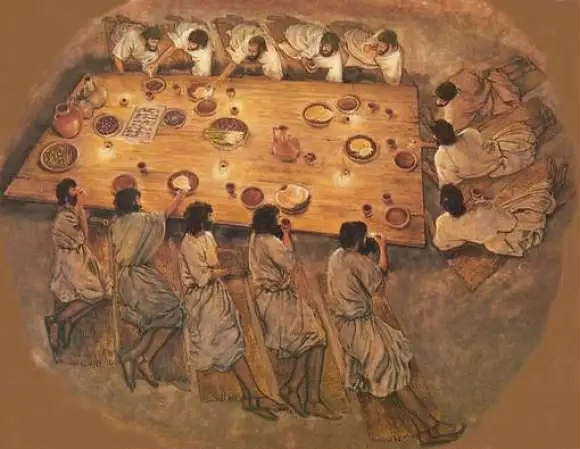
Based on the above illustration, John would be directly to Jesus’ right, because of the reclining position, they lean on their left hand and eat with their right, meaning Jesus is facing right. As John is on Jesus’ right, Peter is most likely on John’s right. Therefore, if Peter is trying to gain insight on who will betray Jesus without having to talk loudly across John, he would have John ask Jesus (v 23). He could lean back as John did or he would simply gesture to gain his attention. John would then lean back to the point where his head is in Jesus' chest, and ask Jesus who would be the betrayer quietly so that he may then whisper it back to Peter (v 24).
Instead, Jesus answers Peter’s question openly to the group. “He is the one for whom I shall dip the piece of bread and give it to him” (v 26). Matthew will state that Jesus dips the bread with Judas, meaning, they are both able to contact the bread together based on their position (v 26). Jesus is also then able to tell Judas, “What you do, do quickly” (v 27), in such a way that no one else is able to hear. Meaning, Judas is located next to Jesus so that maybe only John would know. All of this concludes that Judas is next to Jesus. If John is to Jesus’ right, then Judas could only be to Jesus’ left.
But this has other cultural implications. People were ranked based on where they sat, with the person being on the left as having higher honors. Thus, Jesus being to John’s left is telling. But Peter, who was the eldest of the group, being to the right of John, the youngest, is a continuation of Jesus’ feet washing lesson to Peter. Jesus makes a “last is first” statement by placing John at the forefront. But for Judas to be to Jesus’ left is one last expression of love from Jesus. It was a final gesture. Likewise, for a host to dip a piece of bread and hand it to someone was also considered a sign of honor. Thus, Judas’ position and Jesus’ actions reveal that Jesus was fully in control of the situation.
At this point, John describes, after Judas left, “And it was night” (v 30). As this was already known by context, John’s inclusion of these words now makes it known that, despite all the honor and love that Judas had received, Judas serves his master, Satan, and that his spiritual condition is now symbolically dark. This statement occurs after Judas departed. No longer being guided in the light, Judas has lost his direction and is stumbling in his decision. But all of this was known and intended, because it is at this point, which is Judas’ commitment to betray, that “Now is the Son of Man glorified, and God is glorified in Him” (v 31).
Despite the darkness, the tragedies, the spiritual condition of the world, let it be known that in all of it God is not only in control, but is glorified in it. The response of the world is not necessarily unified, but it is curious. The lost seek the truth and are more open to receive the Word than it has in my lifetime. Though many will still try to pervert the message and draw attention to themselves, God is still glorified in proclaiming His name above all other names. And this is evident in John’s gospel message at what may be construed as the entrance or the moment that darkness appears to be winning.
Semper Reformanda.