
Scribes and Scriptures
Book Review
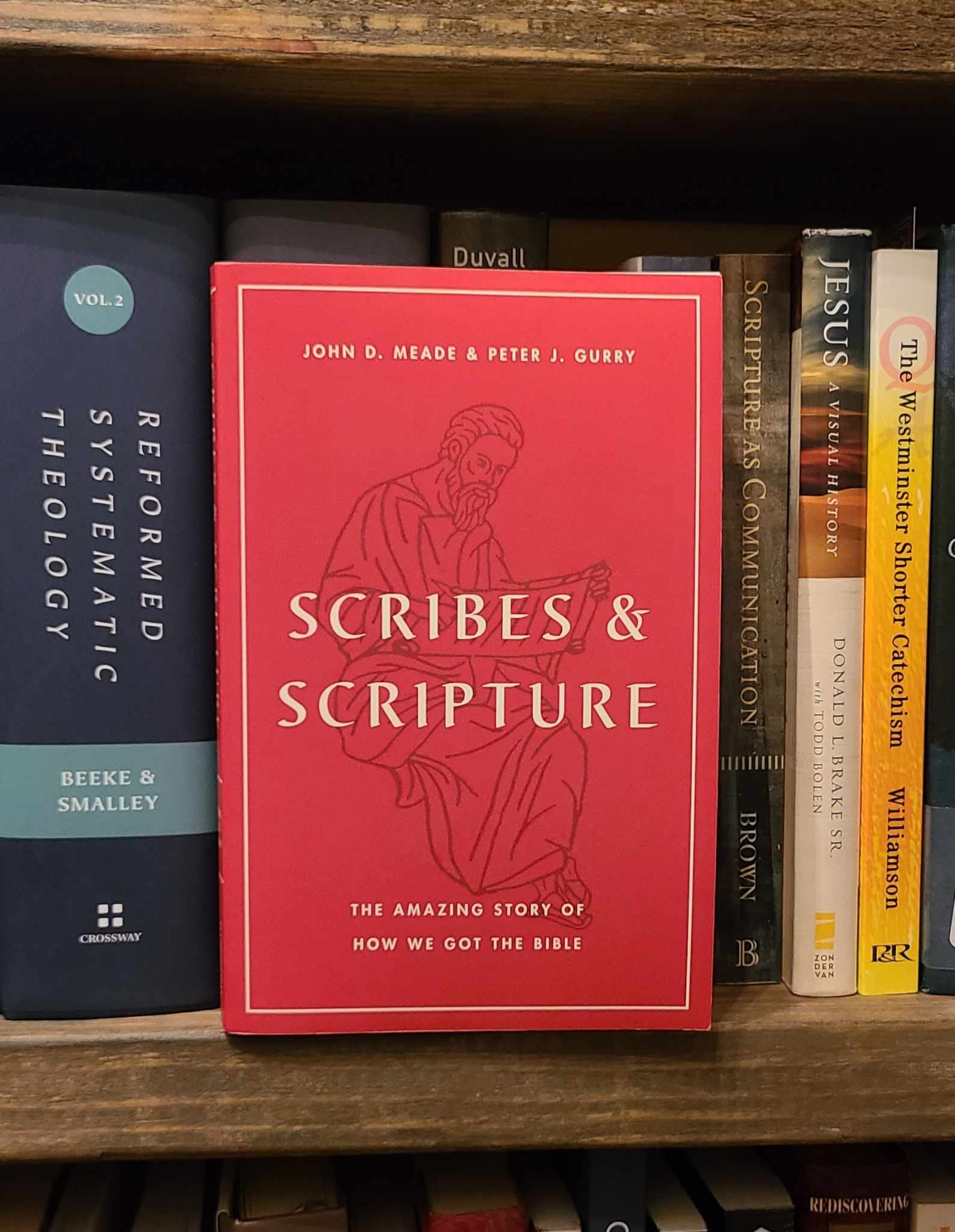
Meade, John D., and Peter J. Gurry. Scribes and Scripture: The Amazing Story of How We Got the Bible. Wheaton: Crossway, 2022.
A truly captivating book, Scribes and Scripture is a piece of the apologetic and scholarly foundation that is beneficial to all. Effectively, the book serves as a crash course in textual criticism navigating through an understanding of archaeological discovery, historical processing, and language understanding that results in the modern English Bibles that are so common within our current culture. The book serves to provide a basic understanding of all the variants from today back to the early church and prior.
The approach taken by Meade and Gurry is to look at Scripture in three parts and further subdivide those into three chapters. Thus, to begin, we navigate the trustworthiness of our Bibles by understanding how manuscripts were copied by various cultures and where researchers have discovered and used these manuscripts to check the accuracy of the text from generation to generation. The authors reveal that Scripture is not without its flaws when looking at it in isolated sections. Giving a glimpse of the entirety of the process reassures us that we have not lost the broader picture and that the necessity of revisions and corrections is due to the further uncovering of manuscripts which indicate what the original autographs were most likely in agreeance with.
“God providentially superintended the preservation of his revelation through the normal arduous work of ancient scribes and translators. Some scribes were more careful than others. Some translators produced more literal translations, while others created more dynamic ones. Some scribes intervened more than others in the copying process. God used all these normal human means to pass down His word faithfully.”[1]
While the finding of manuscripts and understanding the scribal process is highly illuminating, it is the next section that finds itself to be the most useful. Specifically dealing with the canonicity of the Old and New Testaments. While the book gives plenty of evidence to dispel the commonly believed misconception of Constantine declaring which books are and aren’t in reception, it also raises a few issues that are still in dispute. This dispute separates the Western from the Eastern church and the Protestant from the Roman Catholic. Additionally, it attempts to understand the Apocrypha and its historical use and reception.
“Neither protestants nor Roman Catholics in the 16th century created their Old Testament from scratch. Both groups found historical precedents for their canons. The early Reformers and humanists before 1546 promoted the distinction between the authoritative-for-doctrine books and the edifying-for-the-faithful books as they had learned it in the writings of many ancient fathers. After Trent’s decree, the differences between the two Old Testament canons hardened and positions became entrenched.”[2]
The last section attempts to understand why there are so many different English translations today. Secondarily, the authors also address the King James Version’s popularity briefly and provide individuals like myself with more basis as to why a KJV-Only perspective is flawed. Here we understand not just the general history that brought us our translations, but also why. With a broader understanding, it gives us an idea of which translations of the English Bible we may be able to trust and why and in what manner we may need to adjust our perceptions in order to understand what we are reading with the original languages. Of this, I am discussing the spectrum of Word-for-Word or Literal to Thought-for-Thought or Dynamic translations.
“From the beginning, Protestants advocated for the Bible in vernacular languages, and this kept them at the forefront of efforts to translate and distribute Bibles. Nowhere is this more on display than in the history of the English Bible.”[3]
In the end, this book doesn’t answer every question about manuscript varieties or what is the most authentic text to the autographs. The book serves best to reveal the complicated and diligent study and discussions that have brought us our current canons, based on our particular beliefs. Additionally, the book highlights a few problems that exist in current Scripture and the means and methods that translators have sought to mitigate them. But this doesn’t rectify or explain every problem and it is in many of these textual criticisms that you’ll find differing beliefs and ideas from different scholars which could affect some tenets of the faith based on whose explanation you prefer.
My final thoughts on this book are that it does two-fold. On one hand, it may generate a desire or passion for research to compel the next generation to continue taking up the torch and pursuing a path as a textual critic, historian, or translator. Each is necessary as we continue to learn more about God’s self-revelation and propel this to the rest of the world for growth in knowledge and faith. The second stands as another testament to God and His use of providence and free will within our complex history to sustain a relationship with Him. We can then use this knowledge to further defend the faith, teach the next generation the basics, and not be swept up in the fantasy or misinformation that spreads like fire through various social media mediums based on sensationalism.
Finally, what makes this book great is the ease of readability that is often lost in scholarly books. The language is easy to follow and while there are a few times of repetition that one may get lost in some of the details, it is not extensive and normally could be read again and gain clarity. Also, the book has plenty of pictures, and pictures make the reading go by faster and more enjoyable. Therefore, I believe a book on this topic belongs on every believer’s bookshelf and if anyone is unsure of which ones would warrant worth, then I recommend Scribes and Scripture to take that spot until something better arrives.
[1] John D. Meade and Peter J. Gurry, Scribes and Scripture: The Amazing Story of How We Got the Bible (Wheaton: Crossway, 2022), 82.
[2] Meade and Gurry, 144.
[3] Meade and Gurry, 190.